
Autonomous Trucking Goes Mainstream: McLeod Software Integrates Aurora Driver into TMS for Seamless Carrier Adoption
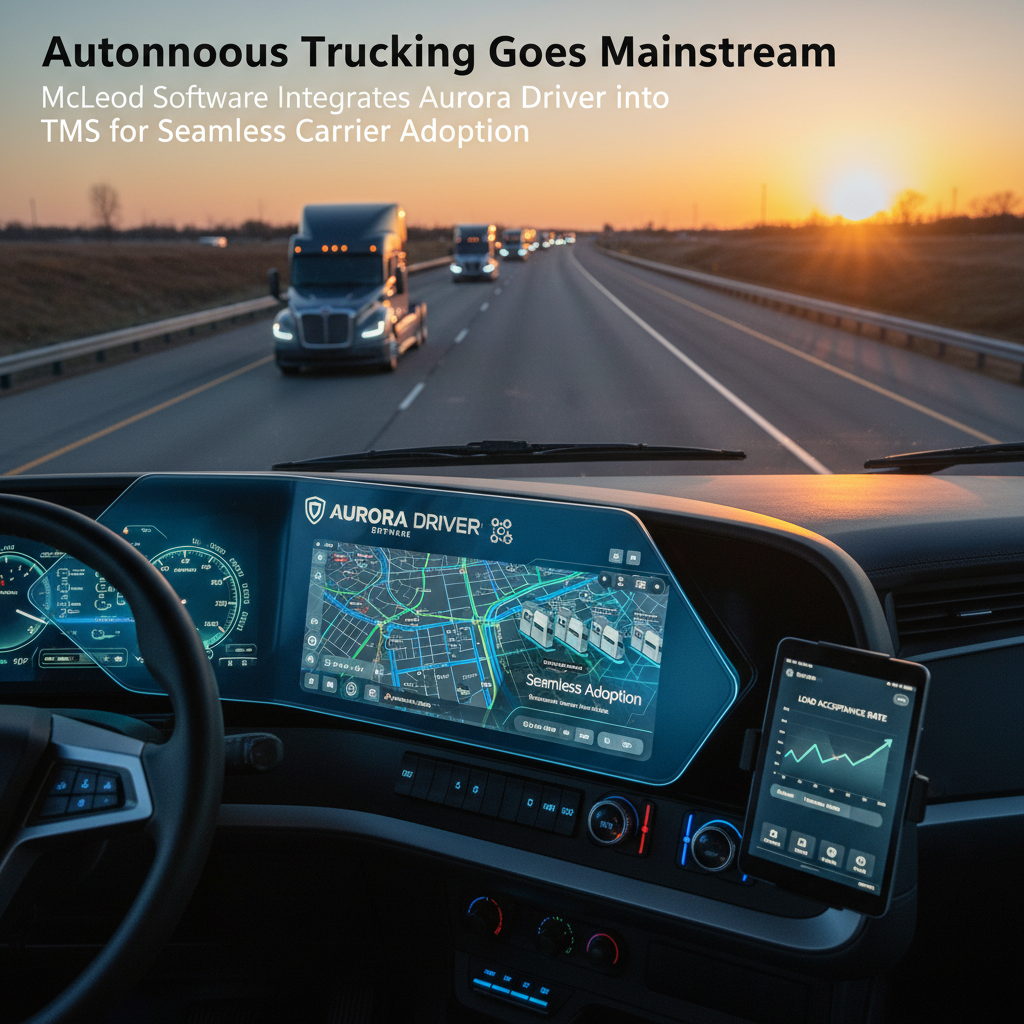
The landscape of commercial freight transportation is undergoing a profound transformation, driven by advancements in autonomous vehicle technology. For CDL truck drivers and fleet managers navigating this evolving industry, understanding the practical integration of these technologies is crucial. A significant step toward mainstream adoption was recently announced by McLeod Software and Aurora Innovation. McLeod, a leading provider of transportation management systems (TMS) and freight brokerage solutions, has successfully completed the integration of Aurora Innovation's autonomous driving technology—the 'Aurora Driver'—directly into its core software platforms, LoadMaster and PowerBroker.
This integration is far more than a technical handshake; it represents a critical bridge connecting cutting-edge autonomous capacity with the established operational workflows of thousands of trucking companies across North America. By embedding the ability to manage self-driving trucks within existing TMS dashboards, McLeod and Aurora are making driverless freight capacity accessible, manageable, and scalable for carriers of all sizes.
The Seamless Integration: What It Means for Fleet Operations
For fleet managers, dispatchers, and operations personnel, the introduction of autonomous trucks into the network requires minimal disruption to daily routines, thanks to this deep software integration. The core functionality is now available to carriers utilizing version 21.1 or newer of McLeod’s LoadMaster and PowerBroker software.
Autonomous Load Tendering Made Easy
One of the most immediate and impactful benefits is the simplified process of load tendering. Previously, incorporating autonomous capacity might have required separate platforms or complex manual data transfers. Now, McLeod users can tender autonomous loads directly through the familiar TMS screen they use every day to manage their human-driven fleet. This means dispatchers can view available autonomous capacity alongside traditional capacity, allowing for optimized route planning and resource allocation.
Real-Time Transparency and Tracking
Visibility is paramount in modern logistics. The integration ensures that once a load is tendered to an Aurora-equipped autonomous truck, dispatchers receive real-time location tracking and automatic status updates directly from the Aurora Driver system. This level of transparency significantly improves operational control. Fleet managers can monitor the progress of driverless hauls with the same precision they track any other unit in their fleet, ensuring timely communication with shippers and consignees and helping to maintain crucial on-time pickup and delivery metrics.
Operational Efficiency Without Disruption
As Rami Abdeljaber, Executive Vice President and Chief Operations Officer at Russell Transport—an early adopter and long-time McLeod customer—noted, the ability to tender autonomous loads through their existing McLeod dashboard resulted in “meaningful operational improvement” and efficiency gains “without disrupting our operations.” This feedback underscores the successful transition from technological novelty to practical, everyday service. The goal is to leverage the efficiency of autonomous technology—particularly on long-haul, middle-mile corridors—while maintaining the operational continuity that carriers rely on.
The Aurora Driver: A 'Driver-as-a-Service' Model
Aurora Innovation is not selling trucks; they are offering a service. Their business model revolves around providing the 'Aurora Driver'—the virtual driver technology—via a subscription or 'driver-as-a-service' (DaaS) model. This approach significantly lowers the barrier to entry for carriers. Instead of massive capital expenditure on new, specialized equipment, carriers can essentially subscribe to autonomous capacity when and where they need it.
Focus on the Middle Mile
Aurora’s commercial strategy, which began with regular freight hauls between major hubs like Dallas and Houston, focuses heavily on the middle mile: long stretches of highway driving where the autonomous system can operate most efficiently and safely. These routes are characterized by predictable conditions and limited complexity compared to urban environments. The human element—the CDL driver—remains essential for the first and last mile, maneuvering through complex city traffic, backing into docks, and managing loading/unloading procedures. This hybrid model, often referred to as 'transfer hubs' or 'drop-and-hook' operations, leverages the strengths of both human expertise and autonomous endurance.
Safety and Reliability
The Aurora Driver is designed with multiple layers of redundancy and sophisticated sensor fusion (Lidar, radar, cameras) to perceive the environment far beyond human capability, especially in adverse conditions or during long stretches of night driving. For fleet managers, this translates into potential safety improvements and reduced risk of fatigue-related incidents on the highway segment of the journey. The continuous, predictable operation of the autonomous system also contributes to better fuel efficiency and reduced wear and tear, optimizing total cost of ownership (TCO) for the asset.
Implications for the CDL Driver Community
While the integration of autonomous technology often sparks concerns regarding job displacement, industry experts and companies like Aurora emphasize that this technology is designed to augment, not replace, the professional truck driver, particularly in the near term.
Shifting Roles and Responsibilities
The most immediate impact on CDL drivers will be a shift in job focus. Autonomous trucks are primarily tackling the long, monotonous stretches of highway driving—the very segments often cited as contributing most to driver fatigue and quality-of-life challenges. This creates new opportunities for drivers specializing in regional, short-haul, and first/last-mile logistics.
- Local and Regional Expertise: Demand for drivers skilled in navigating urban and suburban environments, managing customer relationships, and handling complex delivery scenarios (the first and last mile) will likely increase. These jobs often allow drivers to be home more frequently.
- Transfer Hub Operations: New roles will emerge at transfer hubs, where drivers are responsible for coupling and uncoupling autonomous trailers, performing pre-trip inspections, and driving the autonomous units onto and off the highway access points. These roles require high levels of technical proficiency and safety adherence.
- Technician and Support Roles: As autonomous fleets grow, there will be a surge in demand for highly skilled technicians capable of maintaining and diagnosing complex autonomous systems, including sensors, computing hardware, and specialized braking/steering components. Many current CDL drivers possess the mechanical aptitude necessary to transition into these high-paying technical roles with additional training.
Addressing the Driver Shortage
One of the trucking industry’s most persistent challenges is the chronic driver shortage. Autonomous technology offers a strategic way to address capacity constraints by handling some of the less desirable, long-distance routes. By making the remaining driving roles more regional and predictable, the industry hopes to improve driver retention and attract a new generation of professionals who prioritize work-life balance.
Strategic Takeaways for Fleet Managers
Integrating autonomous capacity requires careful strategic planning. Fleet managers must evaluate their current network, identify suitable lanes, and understand the economic model of DaaS.
1. Lane Suitability Analysis
Not all lanes are created equal for autonomous operations. Fleet managers should prioritize high-volume, repetitive, long-haul corridors (e.g., I-10, I-45, I-80) that connect major distribution centers or transfer hubs. These lanes maximize the utilization of the autonomous asset and minimize the complexity of handoffs.
2. Economic Modeling and ROI
While the DaaS subscription fee exists, the economic benefit comes from 24/7 operational capability (no mandated hours-of-service breaks for the virtual driver), potential fuel savings due to optimized driving patterns, and reduced labor costs on the highway segment. Fleet managers must conduct thorough cost-benefit analyses comparing the TCO of a traditional team-driven route versus a hybrid autonomous/human-driven route.
3. Training and Workflow Adaptation
Even with seamless TMS integration, internal teams require training. Dispatchers need to understand how to properly tender autonomous loads and interpret the specific status codes provided by the Aurora Driver. Maintenance personnel must be prepared for the unique service requirements of these specialized vehicles. Investing in internal education is key to maximizing the efficiency of the new capacity.
4. Regulatory Awareness
The regulatory environment for autonomous trucking is constantly evolving, varying significantly between states. Fleet managers must stay abreast of state-level laws regarding autonomous vehicle operation, particularly concerning liability, insurance, and operational zones. Partnering with technology providers like Aurora, who are actively engaged in regulatory discussions, is essential for compliance and smooth expansion.
The Future of Freight Management
McLeod Software’s integration with Aurora is a powerful example of how technology providers are working to industrialize autonomous driving. It validates the commercial readiness of self-driving trucks for specific applications within the logistics chain. As Tom McLeod, founder and CEO of McLeod Software, stated, they are “the first TMS to put the power of autonomous trucking directly into the hands of our customers.”
This move signals a clear trajectory for the industry: autonomous trucks will handle the predictable, long-distance hauling, freeing up human drivers to focus on the complex, high-value tasks of local delivery and customer interaction. For CDL drivers, this means opportunities for specialization and potentially better work-life balance. For fleet managers, it means access to a scalable, reliable source of capacity to meet growing freight demands, all managed through the familiar interface of their existing transportation management system. The era of integrated autonomous freight management is here, and carriers equipped with systems like McLeod’s are positioned to lead the charge into this new operational paradigm.
Helpful Resources for CDL Drivers
Comments (0)
Sign in to join the conversation
Sign In to CommentNo comments yet. Be the first to share your thoughts!
Explore More
Driver Resources
Educational guides on CDL licensing, salary expectations, and route planning tips.
Browse CDL Jobs
Find your next driving opportunity. Search by location, route type, and CDL class.
CDL Salary Guide
Understand how pay varies by experience, route type, and location in the trucking industry.