
The Economics and Reality of Power-Only Trucking: A Deep Dive for CDL Drivers and Fleet Managers
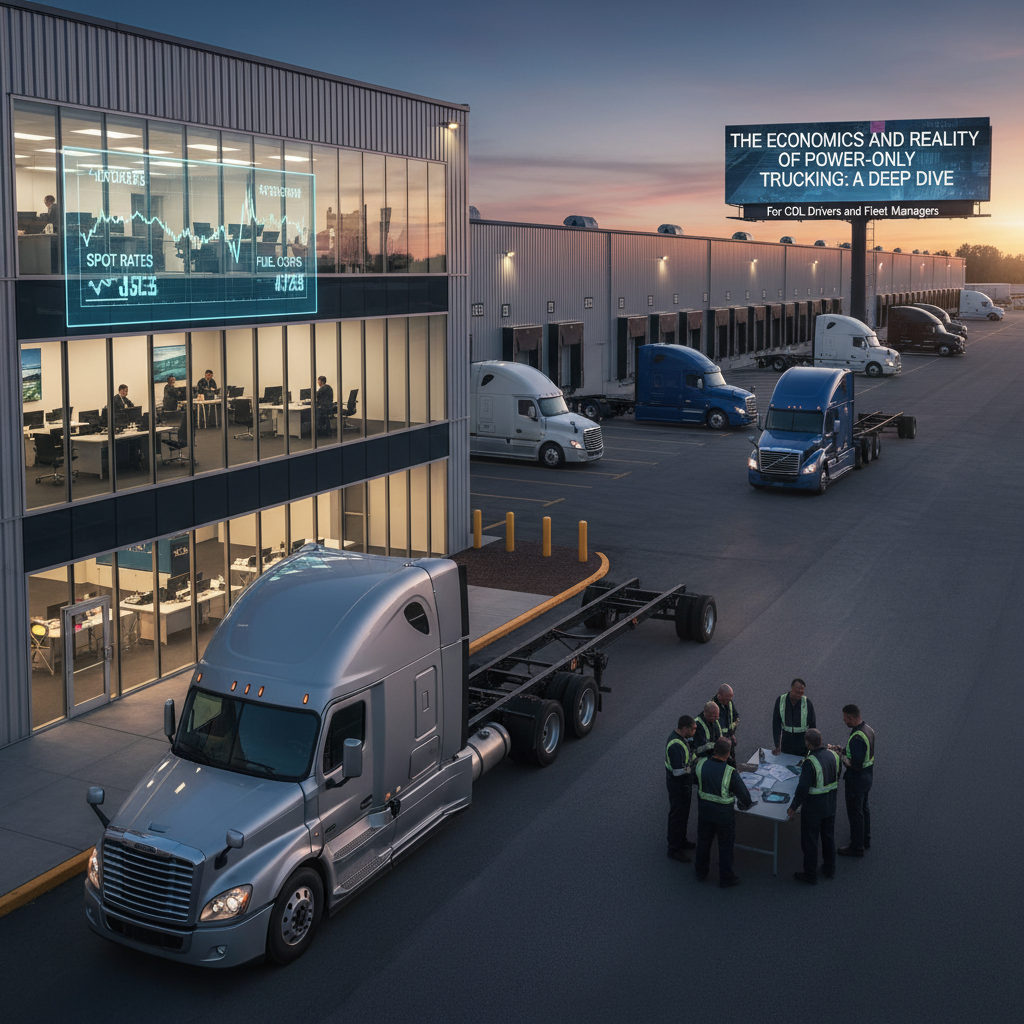
Power-only trucking is one of the most debated and often misunderstood operational models within the freight industry. For CDL drivers, it represents a unique opportunity for streamlined hauls and reduced equipment burden; for fleet managers, it offers unparalleled flexibility and scalability. However, this decoupling of the tractor unit from the trailer unit—the core mechanism of power-only—introduces complexity, risk, and significant operational considerations that both sides must navigate carefully.
To truly understand power-only, we must look beyond the social media debates and examine the fundamental economic challenges it was designed to solve. Trucking has always struggled with the efficient allocation of expensive assets. How can a carrier or shipper ensure they have the necessary hauling capacity (the tractor and driver) when demand spikes, without incurring massive capital costs for trailers that might sit idle during slow periods? Power-only programs emerged as a logical, if controversial, solution to this perennial capacity puzzle.
Defining the Power-Only Model
At its simplest, a power-only arrangement means the carrier or independent owner-operator supplies the tractor (the power unit) and the driver, while the freight owner, shipper, or broker supplies the trailer and the load. The driver hooks up to a pre-loaded trailer, transports it to the destination, drops the trailer, and then moves on to the next assignment, often involving another drop-and-hook operation. This model effectively eliminates the need for the hauling company to own, maintain, or track the trailer assets.
This is not a revolutionary concept; variations have existed for decades in specialized sectors like intermodal drayage, postal service contracts, and large dedicated private fleets. What has changed is the widespread adoption of power-only across general freight, particularly driven by technology platforms that facilitate the matching of available power units with available trailers.
The Strategic Advantages for Fleet Managers and Shippers
For fleet managers running large operations or for shippers managing extensive supply chains, power-only offers several compelling strategic benefits, primarily centered on capital efficiency and operational agility.
1. Reduced Capital Exposure and Asset Management
Trailers—whether dry vans, reefers, or specialized equipment—are significant capital investments. They require ongoing maintenance, tracking, registration, and eventual replacement. By shifting the responsibility for trailer ownership to the shipper or broker, fleet managers can focus their capital expenditures solely on tractors and technology. This allows for a leaner balance sheet and reduces the financial risk associated with owning assets that may not be fully utilized during market downturns. Furthermore, it simplifies asset management by eliminating the complexity of tracking thousands of trailers across various locations.
2. Enhanced Scalability and Peak Season Flexibility
One of the greatest challenges in trucking is managing capacity during peak seasons, sudden volume surges, or unexpected disruptions (like severe weather). Scaling capacity by hiring new company drivers and purchasing new tractors is slow and expensive. Power-only allows fleet managers to tap into a flexible network of independent contractors and smaller carriers almost instantly. This ability to rapidly scale up or down based on immediate demand is crucial for maintaining service levels for sensitive accounts, such as retail distribution or e-commerce fulfillment.
3. Streamlined Operational Flow
In many power-only scenarios, the operation is strictly drop-and-hook. This minimizes the costly downtime associated with live loading and unloading. For a fleet manager, this predictability is invaluable. It improves driver utilization, allows for more accurate scheduling, and reduces the risk of detention time penalties. By optimizing the flow of freight through drop yards, the entire network becomes more efficient.
The Driver’s Perspective: Opportunities and Criticisms
For CDL drivers, particularly owner-operators, power-only can be highly appealing, but it comes with distinct trade-offs that must be carefully evaluated.
The Appeal: Efficiency and Reduced Burden
Many drivers appreciate power-only because it simplifies their day-to-day work. They are responsible only for their tractor’s maintenance and operation. They avoid the hassle of sourcing, financing, and maintaining a trailer, which can cost tens of thousands of dollars and require specialized repair knowledge. The drop-and-hook nature often means less waiting time at docks, translating directly into more miles driven and potentially higher earnings per week, provided the rates are competitive.
The Core Criticism: Safety and Liability Concerns
This is where the model faces its most intense scrutiny. When a driver hooks up to a foreign trailer, they are immediately responsible for its roadworthiness, even if they didn't load or maintain it. If a trailer has faulty brakes, defective lighting, or unsecured cargo, the driver is the one operating the vehicle and is subject to inspection violations (CVSA/DOT). The liability is not eliminated; it is transferred to the operating carrier.
Actionable Takeaway for Drivers: Never compromise on the pre-trip inspection (PTI). Drivers must be meticulous when inspecting the trailer provided by the shipper or broker. Documenting any pre-existing defects (tires, lights, landing gear, securement devices) before pulling out is critical for protecting yourself and your carrier.
Rate Structure and Compensation
Some drivers criticize power-only rates, arguing they should be higher because the driver is providing the expensive power unit. However, the rate structure reflects the reduced operational complexity and the elimination of trailer costs and associated downtime. A well-structured power-only lane should offer a premium over standard dry van rates if it guarantees minimal downtime and predictable turns. If rates are pushed too low, the resentment is justified, as the driver is taking on the operational risk without adequate compensation for the efficiency they provide.
Navigating the Operational Risks: Best Practices
For both fleet managers and independent contractors, mitigating the inherent risks of power-only requires stringent operational protocols and clear communication.
1. Standardizing Inspection Protocols
Fleet managers must ensure that the power-only contracts they enter into mandate clear, non-negotiable standards for trailer condition. This includes regular inspections by the trailer owner and comprehensive pre-trip inspection requirements for the driver. Technology, such as mobile apps requiring photo documentation of the trailer condition upon pickup, can help create an auditable trail of responsibility.
2. Defining Responsibility for Cargo Securement
While the driver is ultimately responsible for ensuring the load is secure before hitting the highway, the initial securement is often performed by the shipper. Contracts must explicitly define who is responsible for providing securement devices (straps, load bars, dunnage) and the standards for loading. Any ambiguity here can lead to dangerous situations and costly cargo claims.
3. Insurance and Liability Clarity
Insurance coverage in power-only arrangements can be complex. Typically, the carrier providing the power unit carries the primary liability and bobtail insurance, while the trailer owner carries the physical damage insurance for the trailer itself. However, the cargo insurance must be explicitly clear. Fleet managers need to verify that their cargo insurance policies cover loads hauled on non-owned trailers, a distinction that is crucial for financial protection.
The Future of Power-Only in the Trucking Ecosystem
What would happen if power-only programs were to disappear? The impact would be significant, leading to immediate capacity constraints and higher operational costs across the supply chain.
Increased Capital Investment
If shippers and brokers could no longer rely on external power units, they would be forced to invest heavily in their own dedicated fleets, including thousands of new tractors and the associated driver payroll, benefits, and management infrastructure. This influx of capital requirement would inevitably raise the cost of moving freight.
Reduced Market Flexibility
The ability to rapidly adjust to market conditions would vanish. During peak holiday seasons or natural disasters, the industry relies on flexible capacity to move critical goods. Without power-only options, bottlenecks would become more severe, leading to delays and potential shortages in consumer goods.
Impact on Owner-Operators
Many small carriers and owner-operators rely on power-only freight to minimize their overhead and maximize their time on the road. Eliminating this option would force them into full dry van ownership, increasing their financial risk and potentially driving many out of the industry, further exacerbating the driver shortage.
In conclusion, power-only trucking is a necessary mechanism that addresses fundamental economic realities in freight movement. While it presents unique challenges regarding safety compliance and liability distribution, these issues are manageable through well-defined contracts, rigorous inspection protocols, and clear communication between the power provider and the trailer owner. For CDL drivers, it offers a pathway to higher utilization and lower asset burden; for fleet managers, it remains a vital tool for maintaining flexible and scalable capacity in an ever-fluctuating market.
Helpful Resources for CDL Drivers
Comments (0)
Sign in to join the conversation
Sign In to CommentNo comments yet. Be the first to share your thoughts!
Explore More
Driver Resources
Educational guides on CDL licensing, salary expectations, and route planning tips.
Browse CDL Jobs
Find your next driving opportunity. Search by location, route type, and CDL class.
CDL Salary Guide
Understand how pay varies by experience, route type, and location in the trucking industry.